Rule of 72 Calculator
The Rule of 72 estimates how long an investment takes to double: divide 72 by your annual return percentage. At 7%, the rule says about 10.3 years, and the exact logarithmic answer is 10.24. This calculator shows both side by side for any rate.
Doubling Time at 7%
The Rule of 72 says 10.3 years; the exact answer is 10.24 years.
- Rule of 72 estimate (72 ÷ 7)
- 10.29 years
- Exact (ln 2 ÷ ln(1 + rate))
- 10.24 years
- Estimation error
- +0.05 years
How do you use the Rule of 72?
Divide 72 by the annual return percentage, and the result is roughly how many years your money needs to double. The calculator above reports three numbers for the rate you enter: the Rule of 72 estimate, the exact doubling time from logarithms, and the estimation error, which is the estimate minus the exact figure in years. A positive error means the shortcut overstates the wait; a negative one means it promises the doubling a little early.
The rule assumes a steady return compounded once a year, the same assumption behind the exact column. It runs in reverse, too: divide 72 by the number of years you have, and you get the return a doubling would require.
Where does the 72 come from?
The 72 comes from the mathematics of exponential growth. Money growing at rate r per year doubles when (1 + r)t = 2, and solving for t with logarithms gives the exact doubling time:
For small rates, ln(1 + r) is very close to r itself, and ln 2 is about 0.693, so the exact formula collapses to a one-step division:
Written with the rate as a percentage, that is 69.3 divided by the rate: the "Rule of 69.3." Everyone uses 72 instead for two reasons, one mathematical and one practical:
- The approximation ln(1 + r) ≈ r understates doubling time, and more so as the rate climbs. Raising 69.3 to 72 offsets that drift almost exactly in the 6–10% band where most investment questions sit.
- 72 is a mental-math gift. It divides evenly by 2, 3, 4, 6, 8, 9, and 12, which covers the rates people actually ask about. Dividing 69.3 by 8 in your head is nobody's idea of a shortcut.
How accurate is it?
Between 4% and 12%, the Rule of 72 stays within 0.33 years of the exact answer, which is more precision than any forecast of future returns deserves. Outside that band the drift shows. At very low rates the rule overestimates (at 1% it says 72.00 years against an exact 69.66), because 69.3 fits better there. From 8% up it flips and underestimates, falling short by 0.20 years at 20%. If a decision actually hinges on the difference, use the exact figure the calculator computes.
| Annual return | Rule of 72 (years) | Exact (years) | Error |
|---|---|---|---|
| 1% | 72.00 | 69.66 | + 2.34 |
| 2% | 36.00 | 35.00 | + 1.00 |
| 4% | 18.00 | 17.67 | + 0.33 |
| 7% | 10.29 | 10.24 | + 0.05 |
| 10% | 7.20 | 7.27 | -0.07 |
| 15% | 4.80 | 4.96 | -0.16 |
| 20% | 3.60 | 3.80 | -0.20 |
Rule of 72 examples
- Earning 6%: 72 ÷ 6 = 12 years to double; the exact figure is 11.90.
- Doubling in 8 years: 72 ÷ 8 says you need about 9% a year. The exact requirement is 9.05%.
- Inflation at 3%: prices double in about 24 years (exact: 23.45), so cash left uninvested loses half its buying power over that span. The inflation calculator puts any amount in today's dollars.
- A 24% credit card: an unpaid balance doubles in roughly 3 years (3.22 at annual compounding). The same rule that flatters savers works against borrowers.
- Counting the doublings you have left: a 30-year-old investing until 65 at 7% has time for 3.42 doublings, so each dollar invested today grows to about $10.68. Wait until 45 and you get 1.95: each dollar becomes $3.87. Delay doesn't shave a little off the end, it deletes your largest doubling, which is why starting early dominates nearly every other choice.
When should you use a detailed model instead?
Use the full future-value math whenever money moves in or out over time, or you need to know when you'll reach a specific target: the Rule of 72 only answers how long a single lump sum takes to double at one steady rate. Real portfolios don't return the same amount every year; a 7% average arrives as a sequence of ups and downs, and the rule speaks only to the destination that average implies, not the path.
It also runs on nominal returns unless you feed it a real one. Money that doubles in 10.3 years at 7% has not doubled in purchasing power if inflation ran at 3% the whole time (see Inflation and Real Returns). For monthly contributions and a year-by-year balance, use the compound interest calculator. To solve for the return or the number of years a target requires, that is what Goal Mode in CompoundFX does.
Go beyond doubling time with Goal Mode
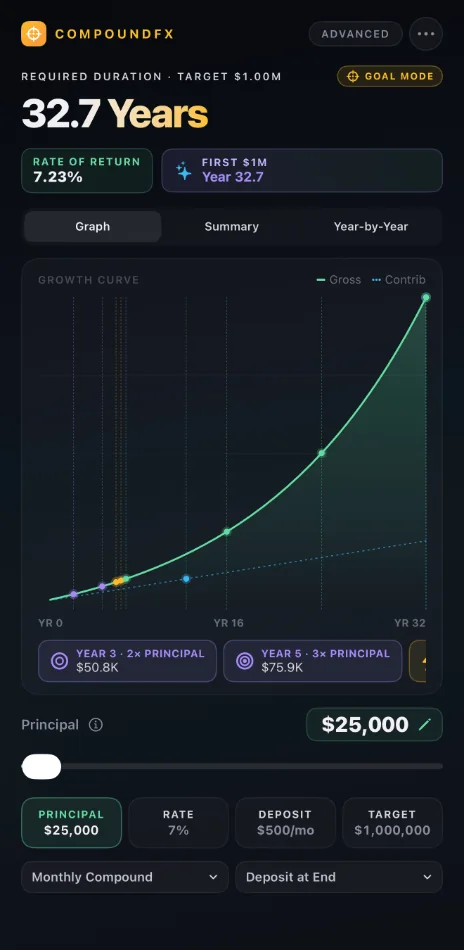
This page solves for one thing: how fast money doubles at a given rate. CompoundFX's Goal Mode runs the question in any direction: the return you'd need, the years it takes, the deposit to start with, or the monthly amount to add.
See how Goal Mode works →
Free to download. Optional one-time Pro upgrade. No subscription.